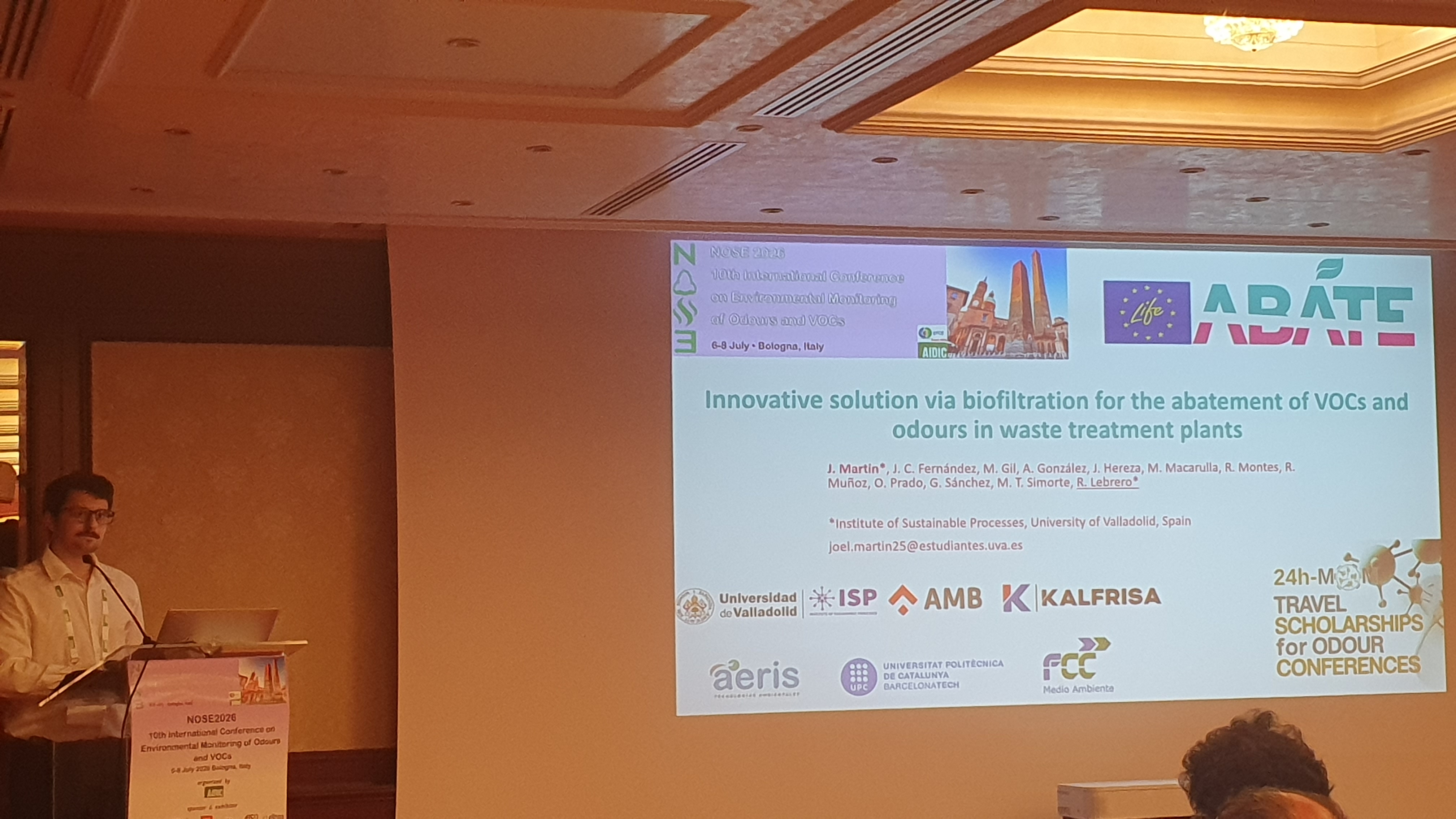
The recipients of the 24h-MOM travel award share their experiences at NOSE26, an event that enabled them to present their work, compare scientific and technical approaches, and strengthen their links with the international odour and VOC community.
The tenth edition of the International Conference on Environmental Monitoring of Odours and VOCs, NOSE26, brought together researchers, consultants, regulators and industry professionals in Bologna to address the main challenges associated with odour emissions and volatile organic compounds. For the 24h-MOM travel award winners, the experience was particularly valuable, both because it gave them the opportunity to present their own work and because of the direct exchange with other specialists in the field.
Joel Martin, a PhD student at the University of Valladolid (Spain), highlights that the conference provided an opportunity to share the work developed as part of the European LIFE ABATE project with an audience already familiar with odour and VOC monitoring and control. Joel emphasises that, following his presentation, questions and comments from the audience helped identify aspects of the project that could be explored further, confirming the value of NOSE26 as a forum for scientific discussion and the exchange of ideas.
Emanuele Caccavo, a Master’s student at the University of Salerno (Italy), focuses on the technical content of the programme. During the three-day conference, Emanuele attended sessions on dynamic olfactometry, odour impact assessment using atmospheric dispersion modelling, emission characterisation and continuous monitoring. Among the contributions that particularly caught his attention were the proposed Odour Fugitive Emission Potential (OFEP) and a presentation on occupational exposure risks in olfactometry associated with compounds with high odour thresholds. He also highlights the opportunity to meet manufacturers such as RSA, Ellona and ARCO Solutions, which presented state-of-the-art technologies for monitoring VOCs and odour emissions.
Zhaohui Yang, a PhD student at the University of New South Wales (Australia), adds a particularly valuable perspective from an experimental and modelling standpoint. During the conference, Zhaohui presented the poster “Odour emissions from rubber granules infills in artificial turf – effect of temperature”, which examined the effect of temperature on odour and VOC emissions from artificial-turf surfaces. His experience at NOSE26 enabled him to discuss his results, learn about work involving CFD applied to H₂S emissions, and explore case studies on public perception, regulation and citizen science in odour management.
Beyond the scientific sessions, all three accounts share a common message: NOSE26 was a valuable meeting point for learning, exchanging ideas and building professional networks. The combination of presentations, informal discussions, poster sessions and contact with industry enabled the participants to broaden their understanding of the field and strengthen the link between academic research and real-world applications.
These experiences highlight the importance of supporting scientific mobility and the participation of early-career researchers in international forums. The 24h-MOM travel award helps new voices contribute knowledge, share their results and continue advancing the development of more effective solutions for odour monitoring and control.
If you find this article interesting, you might also be interested in these articles:
- NOSE 2026 celebrates its tenth edition, reinforcing its role as a key meeting point in the odour sector
- NOSE2026: industrial workshop “Odour & Industry: from concepts to practice” in Bologna
- A new edition of the NOSE2026 will be held in Bologna
- Call for abstracts for the NOSE2024
- NOSE2022 will be held in Taormina, Italy, from 11 to 14 September 2022
- NOSE2020 is going to be held virtually