There is no translation available.

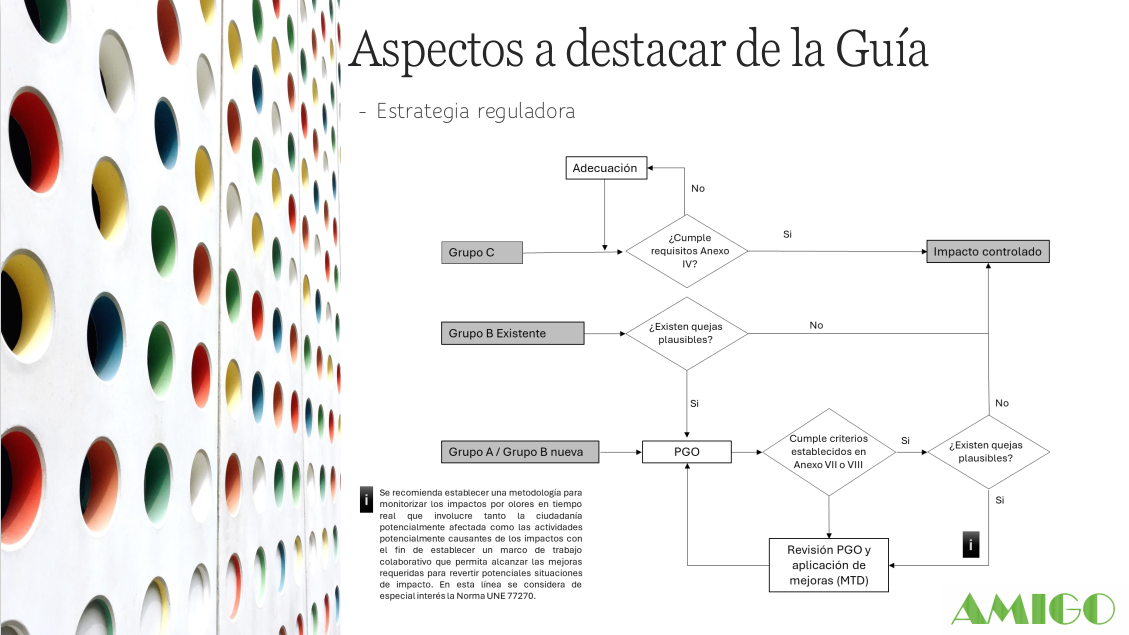
   This guide is designed to help municipalities create ordinances to regulate and control nuisance odors as part of their legal responsibility to manage urban environmental quality.

   Under Article 25 of Law 7/1985 (as amended by Law 27/2013), municipalities must manage the urban environment—including protection from noise, light, and air pollution—according to state and regional laws.

G. Arisa1, R. Bustos2, C. Izquierdo3, J. Burbano4, A. Amo5

1 Av. Corts Catalanes, 5, 08173 Sant Cugat del Vallès, Barcelona / Nave 3
2 Avda. Joaquina Eguaras nº2 -18013 Granada
3 C/Uribitarte, Nº6, Planta Baja. 48001 Bilbao
4 C/ Vilamarí, 50 Barcelona
5 Parque científico de Alicante, Zona ampliación del Campus  Nave 6, 03690 Sant Vicent del Raspeig (Alicante)
*antonio.amo@suez.com

SNPA 2025
There is no translation available.

   The Italian National Environmental Protection Agency Network (SNPA) has published updated guidelines titled "Emissioni Odorigene: Elementi di Riferimento e Approcci Metodologici per il Monitoraggio" (Odour Emissions: Reference Elements and Methodological Approaches for Monitoring). This technical document, approved in January 2025, replaces the 2018 framework and introduces cutting-edge solutions to address one of Italy's most persistent environmental challenges: odour pollution.

   Developed by specialists from 20+ regional environmental agencies (ARPA) and ISPRA, the guidelines reflect Italy's most comprehensive odour management strategy to date. Because this guideline is written mainly by regulators, it has an extensive chapter on the diferent regulations related to odour management nationwide and also at a regional and a local scale. There you will see Italy's fragmented regulatory landscape, with regions adopting different approaches to odour management ranging from composting regulations (Lombardy) to integrated prevention measures (Basilicata). The SNPA 2025 guidelines aim to harmonize these framework.

W dniu 6 grudnia 2024 r. opublikowano nowy dokument referencyjny Komisji Europejskiej dotyczący najlepszych dostępnych technik dla przemysłu kuźniczego i odlewniczego (SF BREF). BREF ustanawia rygorystyczne wytyczne mające na celu zmniejszenie wpływu odlewni i kuźni na środowisko w całej Unii Europejskiej, z naciskiem na zarządzanie i kontrolę zapachów.

Zarządzanie zapachami staje się kluczowym elementem tego nowego dokumentu BREF, odzwierciedlając rosnące obawy dotyczące wpływu zapachów przemysłowych na społeczności lokalne. Dokument wprowadza nowe podejścia do kontroli odorów, w tym obowiązkowe wdrażanie planów zarządzania odorami i zaawansowane techniki monitorowania. Nowe przepisy stanowią znaczącą zmianę w stosunku do poprzedniego dokumentu BREF, podkreślając rosnące znaczenie kwestii związanych z odorami w przemyśle.

Więcej artykułów…