This study analyzes the odor production of Municipal Solid Waste (MSW) in Córdoba, Spain, through physicochemical characterization and the identification of Volatile Organic Compounds (VOCs).
The results show variations in odor emissions based on the season and districts, with the majority composition of VOCs being alkanes, aromatic hydrocarbons, and ketones. Additionally, odor concentration is influenced by the container fill level and atmospheric conditions, reaching up to 100 ou/m³ in nearby areas.
M.A. Martín1*, M. Salinas1, H. Martínez1, E. Muñoz2, M.C. Gutiérrez1, F. Tavares3, A.F. Chica1, J.A. López1.
1 Departamento de Química Inorgánica e Ingeniería Química (Área de Ingeniería Química). 2 Departamento de Física.
1,2 Facultad de Ciencias.
3 Departamento de Mecánica. 3Escuela Politécnica Superior, Universidad de Córdoba. Campus universitario de Rabanales. Carretera N-IV, km 396, 14071 Córdoba.
Competing interests: The author has declared that no competing interests exist.
Academic editor: Carlos N. Díaz.
Content quality: This paper has not been peer-reviewed.
Citation: M.A. Martín, M. Salinas, H. Martínez, E. Muñoz, M.C. Gutiérrez, F. Tavares, A.F. Chica y J.A. López, 2024, Odour Impact Assessment and Mitigation in Municipal Waste Management: Smart Containers, ODORA24 Conference, Barakaldo, Spain, www.olores.org.
Copyright: 2025 Olores.org. Open Content Creative Commons licence. It is allowed to download, reuse, reprint, modify, distribute, and/or copy articles in Olores.org website, as long as the original authors and source are cited. No permission is required from the authors or the publishers.
ISBN: pending.
Keywords: Municipal Solid Waste (MSW), Dynamic Olfactometry, GC-MS, air quality, air pollution, smart cities.
Abstract
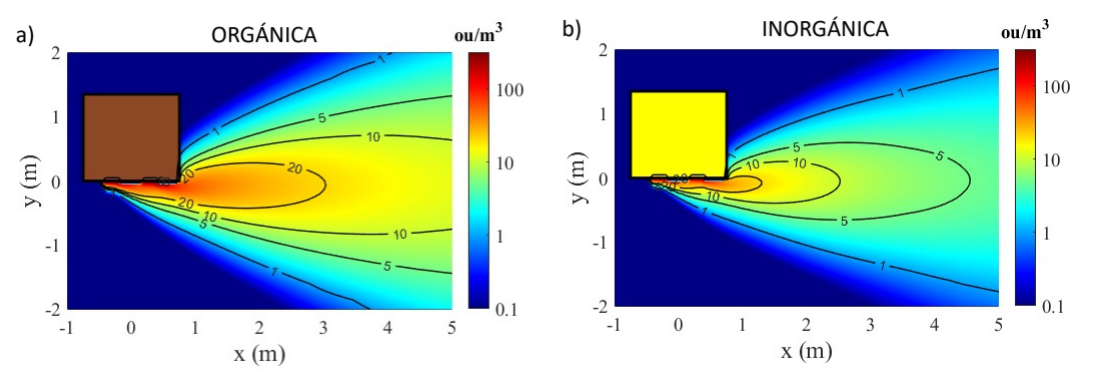
Urban air pollution is one of the most serious pollution problems worldwide (IPCC, 2013). Law 7/2022 establishes the need to take measures for the protection of human health and the environment, particularly regarding the odorous impact of waste, among others. This study analyzes the odorous production of Municipal Solid Waste (MSW) in the city of Cordoba (Spain) through physicochemical characterization, identification of Volatile Organic Compounds (VOCs), and the analysis of its odorous impact. The aim is to promote the transition from conventional containers to "IoT containers" that allows sensorized detection of the most representative odorous compounds families. The odorous emissions differ significantly among the different districts studied in the city, despite the high variability detected at the physicochemical level, not allowing the detection of differences among them (with the exception of pH and N-TKN levels in the inorganic fraction). The analysis of total VOCs shows similar production in both the organic and inorganic fractions, as well as throughout the year and among districts. However, when these compounds are analyzed according to their family, differences are detected based on the season of the year and districts. The majority composition of these VOCs consists of the families of alkanes, aromatic hydrocarbons, and ketones (70%). Filling level and the number of containers determine the concentration of odor emitted, especially under calm atmospheric conditions (v < 0.1 m/s). This means that the inmission levels in the immediate environment can reach levels of up to 100 ou/m³ (50% filling level).
See the full article in other languages:
- French
- Spanish
- German
- Polish
- Arabic