Techniques

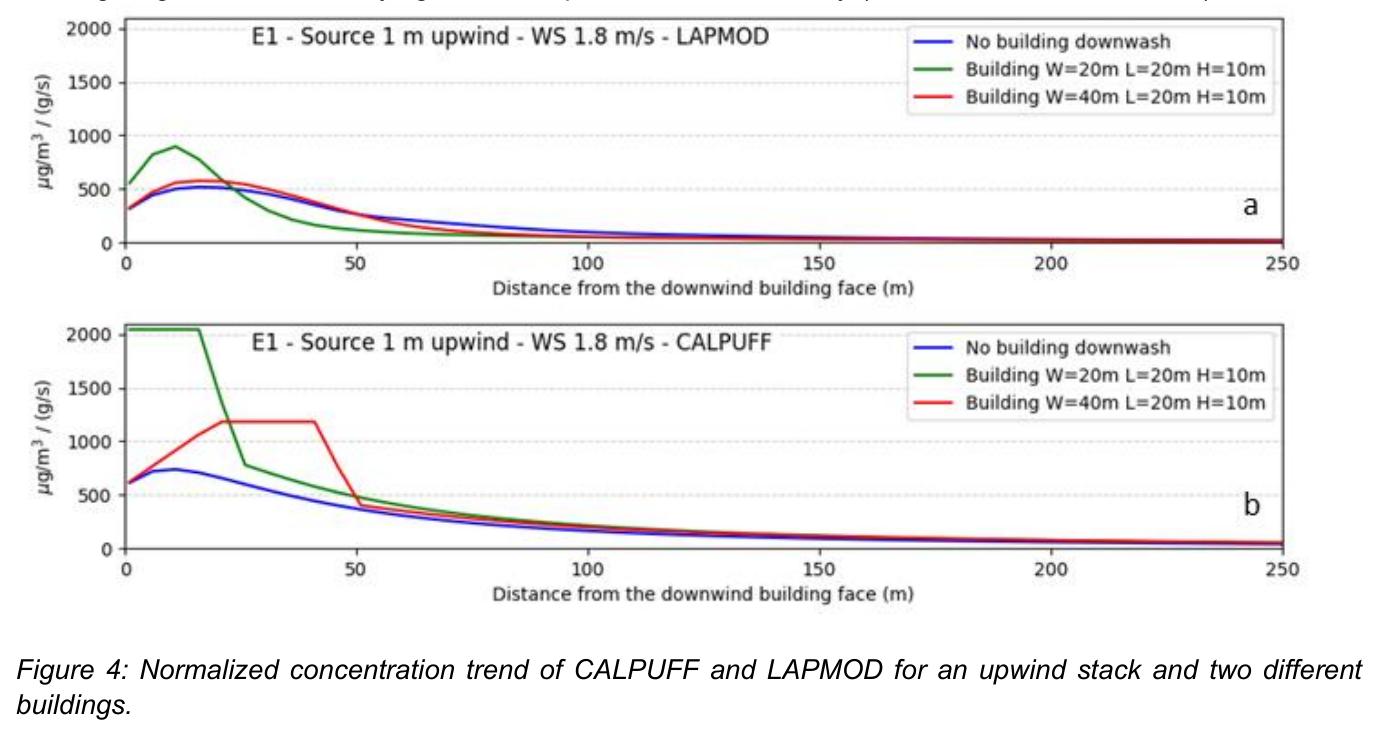
   The open‑source Lagrangian particle model LAPMOD now incorporates the building downwash effect in its algorithm with PRIME2. Designed with odour in mind, it treats downwash at the particle level for point, area and volume sources, removes the need for BPIP preprocessing, and avoids the unrealistic “constant concentration” cavities that can appear with older schemes.

   Odour impacts are dominated by what happens in the first few tens to hundreds of metres from the source. In this near field, buildings can force plumes downwards, enhance turbulence and create recirculation zones that strongly affect ground‑level concentrations at nearby receptors. If a dispersion model gets the building wake wrong, it can easily under‑ or over‑estimate the very concentrations that determine whether neighbours complain or not. That makes the choice of downwash scheme critical for odour assessments around wastewater treatment plants, composting facilities, food processing sites and other installations with complex layouts.

   Scentroid has introduced several improvements to its SIMS3 platform, enhancing the accuracy of emission plume visualization, integrating new monitoring hardware, and refining analytical tools for more robust odour event assessment. These updates aim to provide more reliable representations of atmospheric dispersion patterns and improve data interpretation in environmental monitoring applications.

   Recent developments in the Scentroid SIMS3 system focus on upgrading how emission plumes are modelled and displayed. The standard heatmap representation has been replaced by a custom visualization engine that ensures higher spatial resolution and stability at all zoom levels. This modification eliminates clustering effects common in dense measurement networks and provides better definition near emission sources, particularly under variable meteorological conditions. The result is a more consistent and realistic depiction of dispersion dynamics, improving the interpretation of odour and pollutant transport in complex environments.

  Enviroware, an Italian company specialised in air quality consulting, has released version 7.2.1 of its EW_CALPUFF, a graphical user interface (GUI) dedicated to easily manage the Lagrangian puff model CALPUFF, widely used in atmospheric dispersion modelling for pollutants and odours.

  If you work with odour modelling, you are probably familiar with the dispersion model CALPUFF. This is a propietary, source-available (not open-source) non-steady-state Lagrangian puff model used to simulate pollutant transport, transformation, and deposition, taking into account time- and space-varying meteorological conditions. The official proprietary software (not open-source) CALPUFF core models (CALMET, CALPUFF, and CALPOST) are free to download and can be run via the command line, although the GUI requires a paid licence. In the past, there were several other GUIs available, such as CALPro, CALApps, Beeline, or MMS-CALPUFF but most of these have now been discontinued. Another well-known GUI is this one of the Italian company Enviroware that has been recently updated. This release introduces two new features.

More Articles …