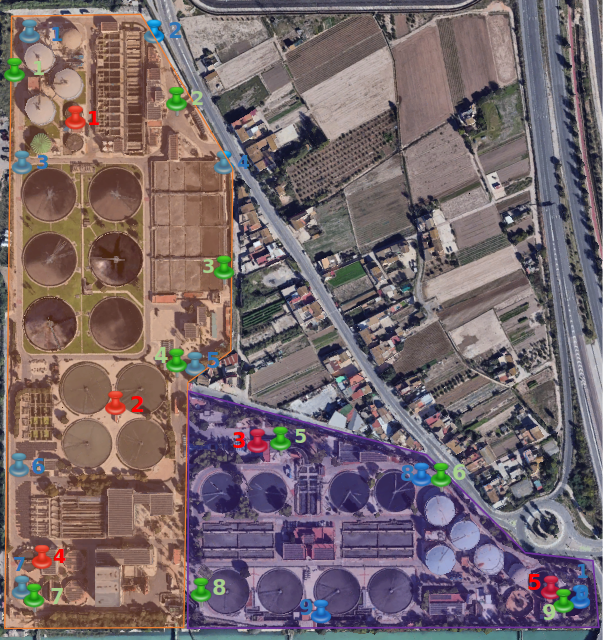
The Pinedo WWTP, serving over 1.5 million people across 18 municipalities near Valencia, has faced significant challenges due to odour issues affecting nearby communities.
To address this, the facility has implemented an innovative project combining advanced monitoring tools, such as real-time hydrogen sulphide and noise surveillance, dynamic olfactometry, odour forecasting software, and citizen science initiatives, to effectively identify and mitigate nuisance impacts. This integrated approach not only enhances technical control but also fosters greater transparency, participation, and trust with local residents.
C. Lafita1*, L. Saúco2, F. Andrés1, A. Jiménez2, E. Albors1
1 Global Omnium Medioambiente S.L., Gran Vía Marqués del Turia, 17, 46005, Valencia (Spain)
2 S.A. Agricultores de la Vega, Plaza Tetuán, 1m 46003, Valencia (Spain)
Competing interests: The author has declared that no competing interests exist.
Academic editor: Carlos N. Díaz.
Content quality: This paper has not been peer-reviewed.
Citation: C. Lafita, L. Saúco, F. Andrés, A. Jiménez, E. Albors, 2024, Management Experience of the World's Largest Integrated Odor Project, ODORA24 Conference, Barakaldo, Spain, www.olores.org.
Copyright: 2025 Olores.org. Open Content Creative Commons licence. It is allowed to download, reuse, reprint, modify, distribute, and/or copy articles in Olores.org website, as long as the original authors and source are cited. No permission is required from the authors or the publishers.
ISBN: pending.
Keywords: Continuous monitoring, odour measurement, citizen science, integrated management, IOMS
Abstract
The Pinedo WWTP serves more than 1,500,000 equivalent inhabitants, treating wastewater from up to 18 municipalities in the metropolitan area of Valencia, with a total flow rate of 325,000 m3/d. It occupies a plot area of 142,652 m². It is located south of the urban centre of Valencia, and due to its location and size, it has historically generated a problem of discomfort due to the impact of bad odours in its surroundings, which has always been a great challenge to solve.
This has led to the bringing together in a single project of several advanced tools with a high level of specialisation, which had never before been implemented worldwide, being especially efficient when it comes to identifying the needs of the affected citizens. As a result, the following items have been implemented: a) continuous monitoring and surveillance of hydrogen sulphide; b) continuous monitoring and surveillance of noise, with the creation of dynamic acoustic maps; c) continuous monitoring and surveillance with IOMS both in emission and immission; d) dynamic olfactometry (UNE-EN 13725:2022); e) odour forecasting software, with back-trajectory calculation and alarm generation, integrating real-time meteorological data into the model with its own meteorological station; f) use of citizen science to establish the correlation and validation between annoyances and odour concentrations or noise levels (UNE 77270:2023 Contribution of collaborative odour maps through citizen science), which allows for an improved degree of communication, participation, transparency and trust with the affected environment.
See the full article in other languages:
- French
- Spanish
- German
- Polish
- Arabic