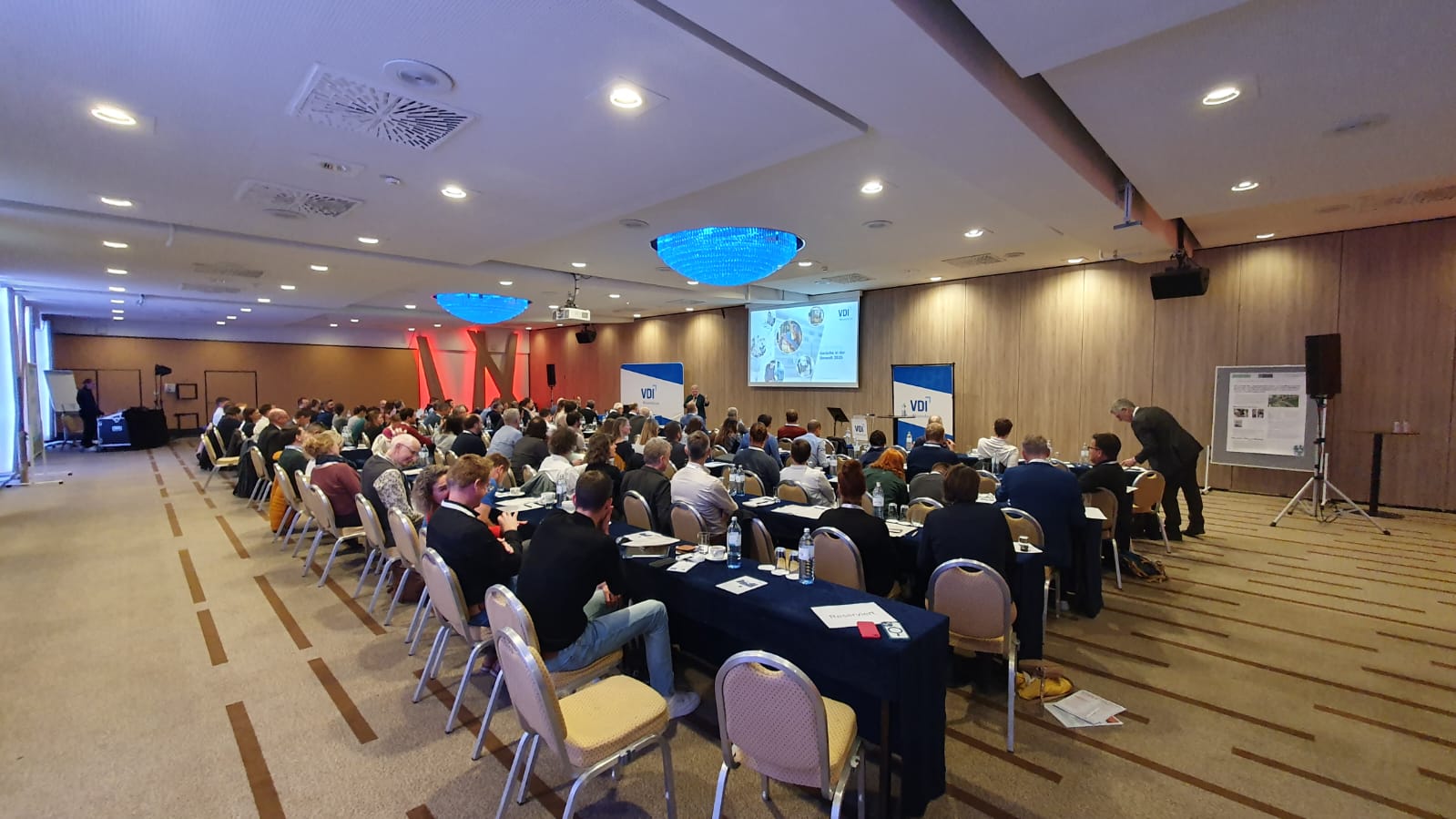
The 11th Conference “Odours in the Environment,” organized by the German Association of Engineers (VDI) held on November 18-19, 2025, at the Wyndham Grand Salzburg Conference Centre in Salzburg, Austria, was a successful event. The presentations were of excellent quality, covering a wide range of topics such as odour dispersion modelling, odour emission and ambient air measurements, legal aspects, and practical case studies. The conference featured engaging keynote lectures, workshops, and discussions that attracted experts and professionals from the odour management field.
The Germans have been working for four years now on the new odour regulation included in Annex 7 of the TA Luft (Air Quality Law). This VDI conference addressed many of the questions and cases that have arisen during these four years of the law’s implementation. The number of cases is huge; in fact, three clarifications have already been issued to clarify certain points of the TALuft.
While the previous conference, held two years ago, focused more on odour from livestock facilities, this one centred on the analysis of the performance of dispersion models, with a special session dedicated to this topic. Germany has been using, since the late 1980s, what is now the European standard EN 16841 Part 1.
At present, it is not possible to evaluate the performance of a dispersion model for odour using the 98th percentile as an odour impact criterion with the Grid method. This is the case for several reasons, one of the main ones being that the four grid points would need to be visited far more times throughout the year than the 104 indicated in the European standard for the measurement to be representative of a full year.
So, the Germans have everything in place:
1) an odour impact criterion based on a verifiable 90th percentile, and
2) dispersion models designed and aligned to meet these criteria.
The models most frequently mentioned at the conference were AUSTAL and GRAL. Several presentations focused on analysing the performance of these models compared with actual field measurements. Elsewhere in the world, where, thanks to Miedema et al., the 98th percentile reigns supreme, such field comparisons are not possible. In other words, the outcome of a dispersion model cannot be verified in practice with a P98 criteria.
This is why part of the discussion centred on more technical aspects of these models, such as whether it is necessary to consider plume rise, or whether it is better to use a fixed peak-to-mean ratio rather than a model that estimates the variance of concentration fluctuations.
The quality of the presentations was outstanding, but that’s no surprise, as this biennial VDI conference series never fails to impress.
If you’re a serious odour manager, it’s absolutely essential to buy the proceedings of this conference. They’re in German, but they can easily be translated into any language with just one click using DeepL.
