The new amendment of the existing regulation on TRS for pulp mills expands requirements for pulp mills in Chile. Currently, there are seven such facilities in this country, located from the Maule Region to Los Ríos.
The Ministry of the Environment reported that the update of the Odour Emission Regulation for Pulp Mills has been published in the Official Gazette today, modernising the standards applicable to Kraft or sulphate pulp production, whose processes can generate odours that affect the quality of life of nearby communities.
The amendment corresponds to the second review of the regulation in force since 1999 and regulates Total Reduced Sulphurs (TRS) the main substances responsible for odour episodes associated with these facilities.
The Minister for the Environment of Chile, Maisa Rojas, stated that “this update reflects a clear commitment to people’s health and well-being. Having modern, demanding, and evidence-based standards enables us to reduce impacts on communities. With this amendment, we strengthen regulation and improve oversight.”
The new standard lowers the emission limits for TRS compounds from Incinerators and Dedicated Power Boilers. It also introduces new requirements and operational conditions for venting systems and defines parameters for the operation of emergency lagoons.
It also establishes the obligation to have continuous online monitoring, a key tool for improving transparency and the supervision of each plant’s actual emissions.
The regulation will take effect on 2 June 2026, six months after its publication, and will be overseen by the Environmental Superintendence. This process is part of Chile’s Odour Management Strategy, which promotes regulatory strengthening to reduce the impacts of such emissions on communities.
For more information, the public record of the process is available at plansynormas.mma.gob.cl, while the guidelines of the Odour Management Strategy can be found at olores.mma.gob.cl.
PRESS RELEASE
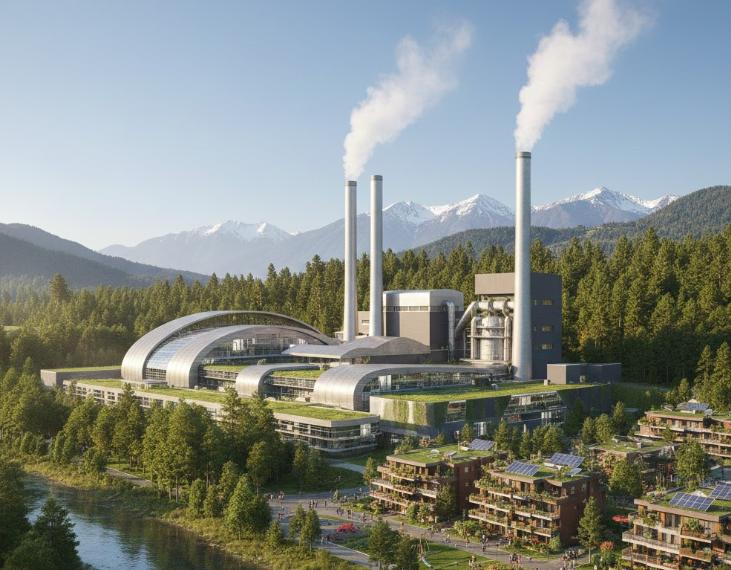
Photo made with the invaluable help of nano banana. This image is clearly not of an existing paper pulp factory, but it could be in the future. As the press release came with no photo, we made one.
If you find this article interesting, you might be also interested in these articles.
- Odorants Atmospheric Dispersion Forecast around a Pulp Mill Plant
- Impact Of Micronutrient Technology In Odor Control Of Wastewater Treatment Plants Of Pulp Mills
- Lessons learned in the elaboration of the first odour regulation in Chile
- Final Draft of the European BREF Document for the Production of Pulp, Paper and Board
