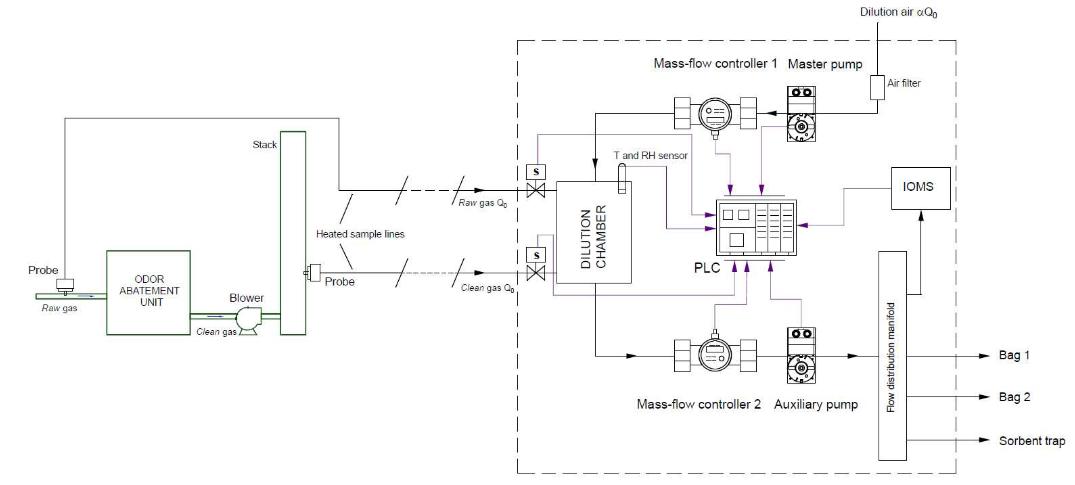
This article presents an approach for continuous duct sampling, designed to feed an IOMS trained with dynamic olfactometry data from the same system. The setup enables sequential sampling of odor inflows and outflows through a reduction device, allowing for efficiency evaluation.
It addresses challenges such as reducing humidity, implementing hardware/software adjustments to account for temperature fluctuations, and developing algorithms to correlate odor concentrations between sampling and the IOMS. Field-calibrated results are presented from a system installed in a waste treatment plant, analyzing both odor fluctuations during the plant's daily cycle and the efficiency of the odor reduction unit.
F. Cangialosia 1*, A. Fornarob 2
1 Tecnologia e Ambiente (T&A), Putignano (BA), Italia
2 Labservice Analytica, Anzola Dell’Emilia (BO), Italia
* federico.cangialosi@icloud.com
Competing interests: The author has declared that no competing interests exist.
Academic editor: Carlos N Díaz.
Content quality: This paper has not been peer-reviewed.
Citation: F. Cangialosia, A. Fornarob, 2024, OSMOTREFF: an instrumental odor monitoring system from fixed emission sources, ODORA24 Conference, Barakaldo, Spain, www.olores.org.
Copyright: 2025 Olores.org. Open Content Creative Commons licence. It is allowed to download, reuse, reprint, modify, distribute, and/or copy articles on Olores.org website, as long as the original authors and source are cited. No permission is required from the authors or the publishers.
ISBN: pending.
Keywords: IOMS, dynamic olfatometry, learning algorithms, condensation, monitoring.
Abstract
In the past few years, significant advancements have been made in the development of Instrumental Odour Monitoring Systems, though very little data is available for IOMS measurement at emission sources and it is believed that the main cause is associated with issues affecting continuous sampling from streams with high humidity. In this paper we show an approach developed for continuous sampling from flow ducts aimed at feeding a trained IOMS with dynamic olfactometry data collected from the same sampling system. The system was devised to sequentially sample from two duct flows, enabling the characterization of input and output odour flows through an odour abatement device while monitoring its efficiency in odour reduction. The primary design issues addressed include: 1) decreasing relative humidity through controlled dilution, 2) implementing hardware and software adjustments to account for temperature fluctuations during extended operation and 3) developing algorithms to establish correlations between odour concentrations obtained through sampling/measurement according to EN 13725:2022 and the instrumental odour concentration provided by IOMS. Here we present the field-calibrated results of the continuous sampling coupled with IOMS: the device was installed across the flow ducts both upstream and downstream of an odour abatement unit within a waste treatment plant. After the final training/calibration, the system operated for several weeks and the collected data of instrumental odour concentration are presented: the analysis covers both the odour fluctuations over the plant’s daily working cycle and the efficiency of the installed abatement unit in reducing instrumental odour concentration.
See the full article in other languages:
- French
- Spanish
- German
- Polish
- Arabic